Insuring Fusion - 3 Key Insights
Insuring Fusion – 3 Key Insights
Insurance rarely makes fusion headlines, but it will help decide which first-of-a-kind plants get financed and built.
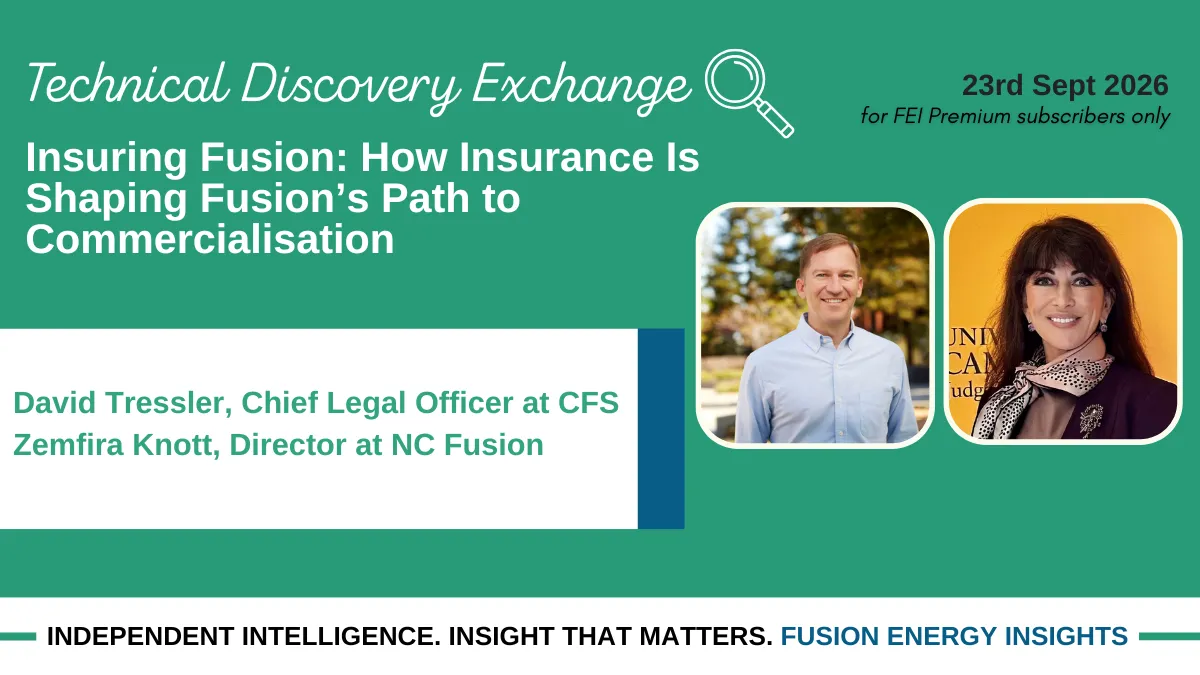
Our latest Technical Discovery Exchange was on Insuring Fusion: How Insurance Is Shaping Fusion’s Path to Commercialisation. Zemfira Knott (Executive Board Director, Northcourt, and Director, NC Fusion) and David Tressler (Chief Legal Officer, Commonwealth Fusion Systems) covered both sides: how insurers think; and what developers need from them.
Here are 3 key insights:
1. Fusion is still very early stage, and therefore difficult for insurers, but it offers great opportunity for insurers in the future.
Insurance runs on the law of large numbers. Insurers price the probability of loss from past experience, and fusion has none. It has no loss history and no operating record. Only a handful of pilot plants are anywhere near needing cover.
That makes fusion a hard sell to underwriters. Every policy an insurer writes ties up money that must be held in reserve in case of a claim, and selling multiple premiums on those policies are what earn a return on that money. Only a handful of fusion projects need cover today. Money set aside for fusion would therefore earn very little, when it could earn far more in busier markets such as offshore wind. Add a risk that is hard to price, and many insurers will wait and see. The few who commit now will be cautious. They may cover only part of a project's value, make developers pay a bigger share of any loss themselves or attach strict conditions. Some still reach for the nearest familiar template.
"I think there are still a number in the market that are thinking of it too much like nuclear fission, and I think they'll get left behind." David Tressler
However, every mature insurance class you can name today started exactly where fusion is now which is unproven and hard to price. Early-stage risks are typically placed with niche insurers, often with tight terms, exclusions, and high deductibles. With time and industry maturity, insurers will collect operational data and claims history that will subsequently improve risk modelling and actuarial confidence in the class. Risk becomes “understood” and moves from specialist underwriting to standard commercial insurance lines. With time and industry maturity two things will happen: available market capacity will rise; and the premiums will fall.
“Like investors, some insurers will lead the way on first-of-a-kind risk, and others will follow once the industry has a track record. Think of a mortgage applicant with no credit history. It doesn’t mean that the person is a bad risk, but there is no data to price the risk against. The pioneers who insure fusion today will set standards for the wider market tomorrow.” Zemfira Knott
The long-term prize is real. Insuring first-of-a-kind fusion risk won’t be easy at first, but it’s a challenge the London market is well placed to resolve.
2. Insuring a new technology isn't new.
The technology is new, but insurers have done this before. Satellites, offshore wind and cyber all began with no data. Offshore wind paid for expensive early lessons on subsea cables. Twenty or thirty years ago, cyber cover barely existed. All three are now established insurance classes.
"Every mature industry class you can name today started exactly where fusion is now, i.e. unproven and hard to price. And in every case, the insurance showed up before the data existed." Zemfira Knott
David argued that fusion's hazards compare more closely with industrial sites that carry low-level radiation or chemical risk than with fission. He has done this before. As Deputy General Counsel at Waymo, he saw autonomous driving earn insurer confidence through dedicated studies and data.
"It is not an exotic risk, and it actually is a pretty well-known risk with new technology." David Tressler
So fusion doesn't need a new process. It needs to move down the familiar curve, from specialist niche to standard commercial lines.
3. It pays to engage insurers early.
Premiums reflect what insurers don't know. If developers bring insurers in at the last minute, Zemfira says, they are asking them to insure a locked box.
"The sooner insurers are in the room, the cheaper the risk is to manage, and the cheaper the premium ends up being… The more assumptions insurers make, the higher the premium." Zemfira Knott
"The task for the industry is to try to reduce the time from the first of a kind leaps of faith that insurers are going to make to maturity based on data and engineering assessment, and so earlier engagement can reduce that time." David Tressler
Insurers sit at very different points on the learning curve. Some are still asking whether fusion is coming at all. Others are ready to go through peer-reviewed physics papers or hold discussions under NDA. CFS works at both levels. It takes the "fusion is not fission" message to industry events and holds detailed one-to-one sessions with insurers who are further along. Builder's risk cover on today's facilities gives insurers a way in long before a first-of-a-kind plant needs operating cover.
Most of the insurance market is still at the awareness stage. The fusion sector should be building that understanding now, before it needs the cover.
To go into more detail, download our report Fusion on the Horizon: What Insurers Should Know.
