Microgrids and Fusion, a Faster Route to Market? - 3 Key Insights
Microgrids and Fusion, a Faster Route to Market? - 3 Key Insights
Most fusion business plans end at a grid connection. Paul Stein thinks the faster route to market may not involve the grid at all.
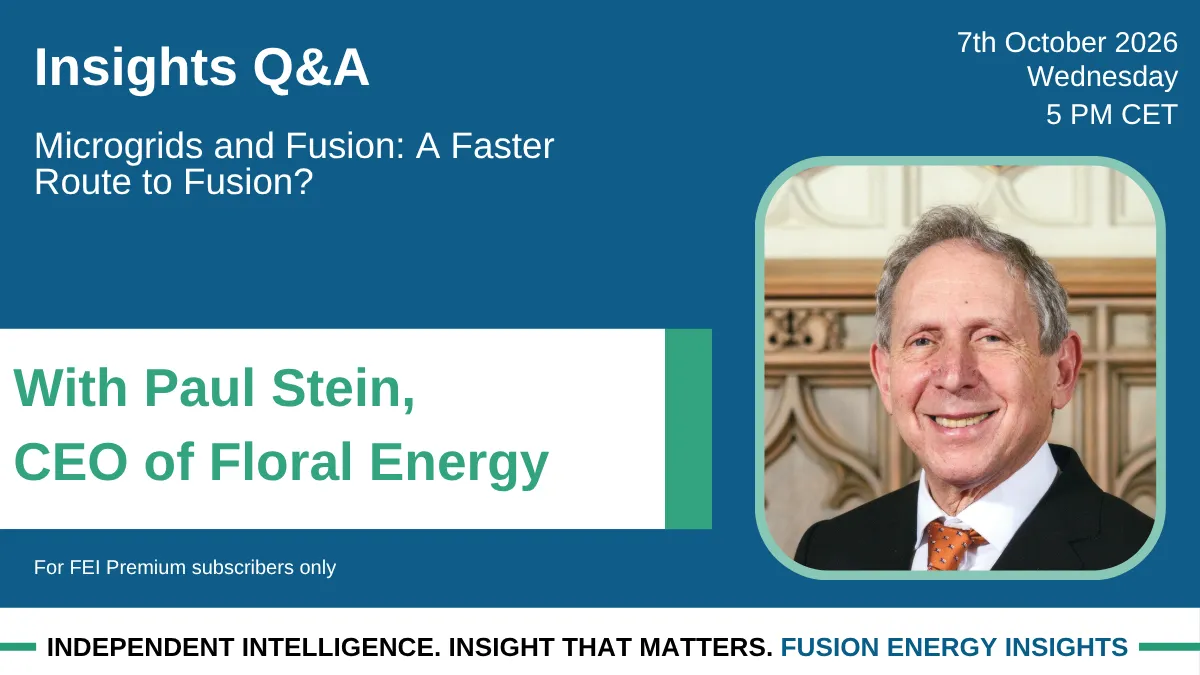
At our latest Q&A event on 7 October 2026, we spoke with Paul Stein CBE, CEO of Floral Energy. Paul was formerly CTO of Rolls-Royce and chaired its spin-out Rolls-Royce SMR. He has advised Zap Energy and served on the Prime Minister's Council for Science and Technology. Floral Energy builds off-grid microgrids for data centres, planning to supply power from gas in the near term with fission or fusion phased in as each becomes available.
We discussed why AI is forcing the pace, what bundling does for fusion's commercial case and how the integration works in practice. Here are our 3 key insights.
1. AI demand is moving faster than the energy industry can build, and the grid can't close the gap
AI data centres start at around 50 MW, and some campuses are being planned at 500 MW to 2 GW. Low-cost nuclear, either fission or fusion, is unlikely to arrive in quantity before the mid-2030s. Paul expects fission supply to lag demand well into the 2040s.
"AI is here and now. It's rolling out now. The capacity is needed now," he said.
Customers have made their priorities clear. "The first thing they'll ask is ‘when?’, Paul said. “Not ‘how much?’ not ‘what type of electrons am I going to get?’ not ‘is it gas?’ but ‘when can you give me the power?’ The whole energy industry, bit by bit, is falling behind the AI industry."
The grid can't close that gap. In Paul's view, planning and regulation move "at a pace about a tenth of the speed of the world of AI". So data centres are going off grid, and that changes who pays. Big tech funds the power directly, owning the capital or the offtake, and takes its bets on nuclear without waiting for utilities or governments. A gas microgrid can be running within about two years, and fission or fusion can follow as it matures.
2. The microgrid absorbs fusion's uncertainty, so the customer doesn't have to
Paul expects early fusion plants to run in bursts, coming offline for maintenance and component replacement. That makes availability—not just cost—the defining commercial question. "A system that operates for 10% of the time has got a ten times cost of energy headwind," he said.
Bundling changes the equation. The customer buys continuous power as a service. Gas fills the gaps, and fusion is switched on whenever it is available. "The microgrid doesn't care about the answer," Paul said. "The microgrid smooths over all of those cracks."
In the model Paul described, a special purpose vehicle owns both the fusion plant and the microgrid, and the customer pays the gas bill directly. Floral carries construction and reliability risk, but not the risk of which energy source is running.
It is a lesson from fission. With SMRs, Paul found customers weren't interested in buying a reactor on its own. "They just want to buy a system. They're handed over the keys, and out comes electrons."
It also lowers the bar for first-of-a-kind plants. "Even if it works 10% of the time, that might be enough of a step in the direction of fusion to keep the end customer happy," Paul said. "Whereas selling a standalone plant that works 10% of the time, forget it." For investors, a bundle that earns offtake revenue now "could herald a complete change in money flowing into fusion".
3. The site is designed for fusion from day one, which means fusion can plug in as soon as it's ready
Floral's building block is a 50 MW data hall, covering around six acres. Beside it sits a rotunda of 22 generators, each 2.5 MW, that can burn gas, hydrogen or biogas. There is also a thermal recovery building and a reserved patch for fusion.
The layout is flexible. A 200 MW data centre would have four 50 MW halls, and a 200 MW fission SMR can simply be split to feed all four. Fusion is less certain, because nobody yet knows what size or output commercial fusion plants will be. Floral would work out the arrangement with each fusion company: one plant per hall, or one serving several. A 150 MW plant, for example, could feed three halls. "As long as the costs are right and the reliability is right, I think the rest is detail," Paul said.
Thermal recovery is where some of the ingenuity sits. Floral converts low-grade heat from the data hall's liquid cooling loops, at about 45°C, back into electricity. It recovers around 7% of input power, or roughly 3.5 MW on a 50 MW hall. The data centre industry has long treated that heat as waste. Floral has just filed patents on its approach.
The microgrid and fusion plant also share infrastructure such as control rooms, cyber protection, security and a thermal recovery system that can take fusion's waste heat too. The microgrid can supply ignition energy to start a fusion plant at a remote site, and its batteries can store fusion's surplus output. The aim, Paul said, is to put "as much plant as possible" in place when the microgrid is built, "to speed the time that the fusion system will come online".
The hard part is reliability. Off grid, with no backup, customers want 99.995% to 99.999% availability from a system whose fusion element will switch on and off. Floral is borrowing from aerospace, using failure mode and effects analysis to show the whole system is workable.
And finally
Not every fusion company has welcomed the idea. Paul described "quite a polarised reception". Some see an energy-as-a-service deal as "almost a no-brainer" for bringing in revenue now. Others have been hostile. His reading: companies that "slightly overpromised on when they can deliver power" see pairing with a microgrid as "an admission that they're not going to be able to supply the power" on time.
Paul is candid about his own incentives. "Cynically, we earn money when low-cost nuclear is delayed," he said. But in ten years, he would like to see customers "switching off some of the microgrid elements because low-cost nuclear is up and running".
The replay of the full event is available to all FEI Premium subscribers in our Circle hub.
